How to bill a tooth extraction with medical coding — and why most practices are leaving money on the table.

Let me say this directly: most dental offices have no idea this is possible NOT TRUE. The dentist knows. It can be done. And most patients have no idea they could have been reimbursed but the dentist didn't try or decided for them.
When a tooth extraction is driven by infection, periapical abscess, bone destruction, or a documented medical condition — it is not just a dental procedure. It is a medically necessary surgical intervention. And medically necessary procedures belong on a medical claim, filed with medical insurance codes, not just a dental claim with CDT codes using medical insurance coverages.
This is not a loophole. This is how the billing system is supposed to work when it's working correctly. The problem is that most dental offices were never trained in medical coding — and most patients were never told the option existed.
I've been in this field for 26 years. What I'm going to walk you through is the framework that actually gets claims paid. Not theory. Practice.
Here is how you do it!
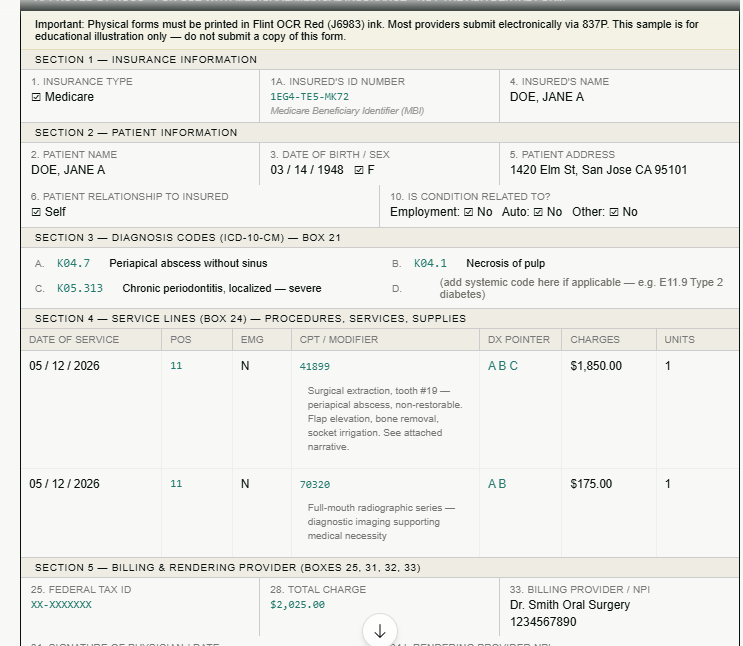
The form you need is the CMS-1500. That is the standard medical insurance claim form. Once you have the right form, the claim lives or dies on two things: the ICD-10 diagnosis codes that tell the insurer why the work was done, and the CPT procedure codes that tell them what was done. You need both. One without the other is a denial waiting to happen.
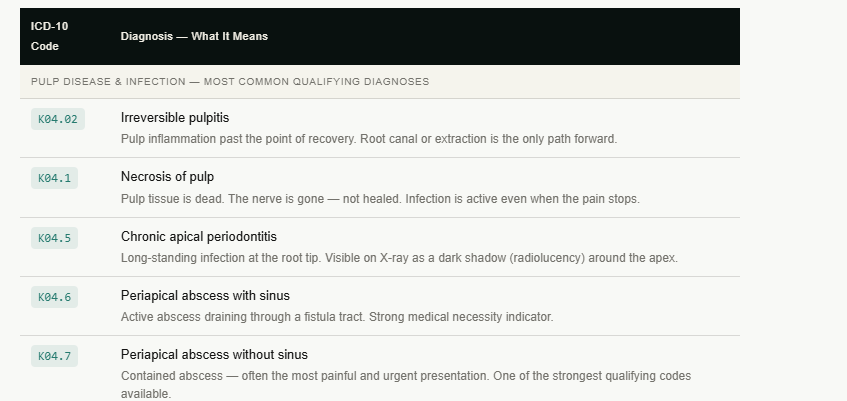
ICD-10 codes — the "why"
ICD-10 codes are diagnosis codes. They describe the patient's condition — the clinical reason the extraction was medically necessary. This is where most claims fall apart. Dentists are trained in CDT codes, not ICD-10. But medical insurance reads ICD-10 first. If the diagnosis code is missing, wrong, or doesn't match the procedure, the claim stops there.
Here are the codes you need to know for extraction cases:
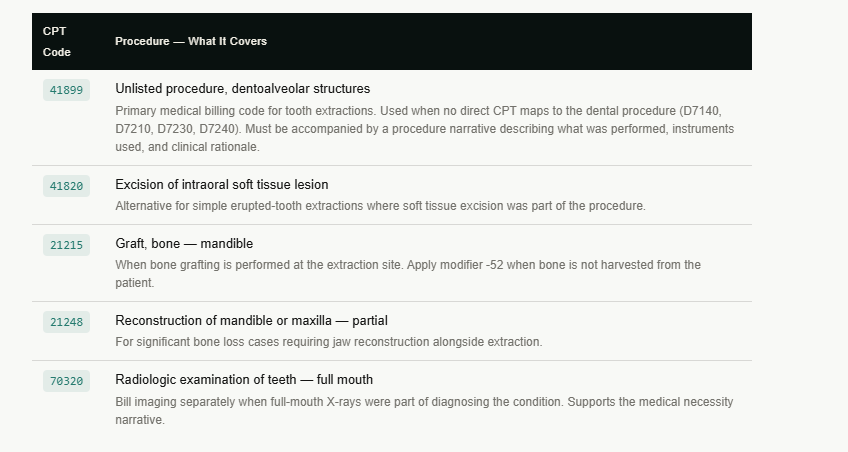
CPT codes — the "what"
CPT codes are procedure codes. They tell the medical insurer exactly what was done surgically. Dental extractions do not have clean CPT equivalents — which is why most practices get stuck. The primary code is an unlisted code that requires a written narrative. That narrative is not optional. It is the claim.
Then you put it together! Sample 1
Why most practices stop here — and what we do instead
Everything above is real. And I will also be honest: this is a lot. Most dental offices were never trained in medical billing. The form is different. The codes are a different language. The narrative requirement alone stops most practices cold — because writing a procedure narrative that satisfies a medical insurer's review is not the same as writing a dental chart note.
I have been in this field for 26 years. I have seen practices try this on their own and get denied repeatedly — not because the patient didn't qualify, but because one box was wrong, the diagnosis pointer wasn't linked correctly, or the narrative was missing entirely. And once a claim is denied, reopening it costs more time and energy than getting it right the first time.
This is exactly what www.YesOnUs.com exists to handle.


