Root canals: what you were told, what's true.

What is a root canal? Google says over 3,600 people search "root canal" every single day. That's a lot of people in pain, scared, and looking for a straight answer. Here's mine — after 26 years in dentistry.
Most of the time, when a patient finds out they need a root canal, they are already in pain. Real pain. The kind that keeps you up at night, that makes it hard to eat, that you've been ignoring for longer than you should have — because you didn't have coverage, because nothing was hurting before, or because, like so many people, you were afraid of what the dentist might find.
I've been in dentistry since 2000. What started as a part-time job to pay for school became a 26-year career. And I've seen this same story play out thousands of times. A patient finally comes in. They're in pain. They're scared. And now they're being handed a treatment plan they didn't budget for, with a decision they have to make right now.
That is not okay. And it's why I'm writing this.
"3,600 searches a day. That's 3,600 people looking for an honest answer. This is mine."
So what is a root canal?
Every TOOTH has a soft center called the pulp — nerves, blood vessels, living tissue. When bacteria get deep enough into a tooth through a cavity, a crack, or an old filling that's breaking down, they reach that pulp and infect it, AND NOW PAIN STARTS. Once that happens, the pulp can't heal itself. The infection grows. It spreads to the bone around the root. And if you leave it there, it doesn't stay in your mouth — it travels.
A root canal removes the infected pulp, cleans out the canals, seals the tooth, and saves it. That's its one job: saving the tooth.
The part of this conversation nobody's having
After 26 years in this field, there's something I believe deeply — and it took a book to crystallize it for me.
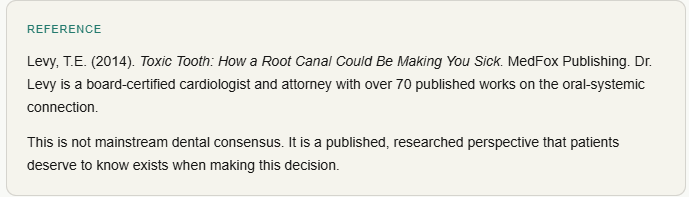
A good friend and mentor of mine, Dr. Thomas Levy — a cardiologist — wrote a book called Toxic Tooth. I want to be clear: this was one research perspective, one book. But it changed how I think about root canals completely.
His argument — backed by his own research — is this: a root canal saves the tooth, but a root canal-treated tooth is essentially a dead tooth. The circulation is gone. The immune system can no longer reach inside it. And according to Dr. Levy's work, the bacteria that remain inside that sealed tooth — anaerobic bacteria, surviving without oxygen — can leak toxins into your bloodstream, directly linked to cardiovascular disease and other serious systemic conditions.
I'm not telling you this to scare you away from root canals. I'm telling you this because you are about to make a decision that affects your whole body — not just your tooth. And you deserve to have the full picture in front of you when you make it.
"You might be paying thousands of dollars to save a tooth. The question nobody asks is: what might that tooth cost your heart?"
Before you make any decision — please know this!
We all want to be healthy. Not just today. Long term. We want to save money now and still be around to spend it later. A root canal might save your tooth. But if there is any chance it's contributing to something bigger happening in your body, you need that information on the table too.
Ask your dentist about the research. Ask them about the oral-systemic connection. Ask them what happens to your jaw, your adjacent teeth, and your bite if you choose extraction. Ask them what replacing that tooth would look like, and what it would cost.
In my next post, I'm going to walk through the replacement options — implants, bridges, partial dentures — so that decision is just as clear as this one.
Because this is your health. Your mouth. Your body. And you deserve to understand exactly what you're choosing — before you choose it. I WILL COME BACK WITH..



